Showing posts with label delhi. Show all posts

Sunday, May 15, 2016

Agrasen ki Baoli


Step wells have recently been "rediscovered" in India. Or perhaps it is more fair to say brought back to the awareness of locals and tourists alike. There are several scattered around Delhi, and while my family was visiting we took the opportunity to stop at Agrasen ki Baoli in central Delhi, in the middle of the modern city. Originally dug down to allow residents access to water (after a descent of 108 steps) it is now mostly dry (just a bit of damp at the very bottom) although a residence for a bat colony. It is a popular spot for the locals, where they hang out, use it as a backdrop for photo shoots or just relax on the steps.


Originally thought to be built somewhere between 1320-1520 due to its architectural style, it actually was full of water until at least the 1970s, when Delhi's growth and development resulted in drastically lowering the underground water levels. Buried in mud and silt it took work on the part of the Archeological Survey of India to restore the site. However, this unique spot seems well worth the work.


You can read more about it here, and even find directions.

Sunday, March 27, 2016

Street art walking tour

My favorite mural of the day
The same festival that took me out to the dry port to see the murals painted on shipping containers also picks one neighborhood a year to get painted with murals by artists that are both Indian and from other countries. When one of the teachers at a school organized a walking tour of the street art in Shahpurjaat (site of the 2014 ST+ART festival) and Lodhi Colony (site of the 2016 ST+ART festival) I couldn't resist putting on good walking shoes and joining in.

The fun thing about art is you never
know what will speak to you
Shahpurjaat is a bit of a windy neighborhood, where you can turn a corner and be surprised at what lays before you....or as was often the case for me, turn around from taking one picture and be surprised at what else laid behind me. A couple of my favorites there included the giant slingshot boy, the black and white huddled person, a piece from the Bollywood Art Project (which I was informed anyone who watched Bollywood would recognize...that isn't me!), as well as a woman protecting herself with her voodoo pins.

Hard to not love some more trees!
In Lodhi Colony the wall spaces were more spacious, and it was evident when you were approaching a mural. I was most drawn to a colorful geometric depiction of birds, but also stunned at the detail in a two story mural of one of the street food vendors that feeds hundreds of people each day in the neighborhood (the fact that we actually got to tell the artist how much we appreciated it as he was taking pictures of his work that he had just finished the day before just made it that much more special). A geometric Gandhi was immediately recognizable. An astronaut on top of a meteor a bit confusing. A piece done by a traditional India artist who had never before worked beyond a canvas was all the more charming for his realizing he'd have to incorporate some typical street art methods (using stencils to add birds to the grown out tusks of his elephant).

There was a lot of variety in the murals.
This one is of a dead Dahlia
The timing might have been difficult with a 4 am departure the next morning for Minicourse, but I'm glad I took the opportunity to see some more of the street art that has come out of this festival.

Our guide was Himanshu of 1100 walks in Delhi. 

Saturday, February 7, 2015

Upcoming elections

The past few weeks there have been cars and auto rickshaws driving around with speakers playing messages at all hours of the day. It never fails that as I turn off my lights to curl up in bed, one goes right past my house, blaring a message in Hindi. What is going on?


Well it is election weekend in Delhi. An election that I know nothing about...but Adam Rugnetta,  one of the teachers at school creates cartoons for his students every day, and one this week provided a succinct look at why these elections are so important. (Thanks Adam! I don't feel quite so ignorant now.)


You can see more of his work here.

Sunday, October 19, 2014

Devils Circuit


Last weekend we drove two hours to get to the outskirts of Delhi to take part in the Devils Circuit - a mud run/obstacle course that occurs twice a year here. The drive was so long because we had to get out to the construction site for Wave City, after all where else could you lay down a 5 km track, dig holes, make several pits of mud and in general make a mess of a space? A construction site has the added benefit of already coming with some of its own obstacle like the giant concrete pipes we clambered over and ran through. There we about 12-15 different obstacles to get across, although the benefit of participating in the non-competitive section was that it didn't matter if we chose not to do some. I generally did one section of an obstacle and then skipped the two repeats that followed. I was surprised to find that it wasn't as strenuous of exercise as I had anticipated (perhaps because I walked around too much of it), but I definitely came home covered in mud and with bruises just about everywhere.

Photo op in the middle of the race...Why not? We're not really competing.

We had a group of about 20 teachers and spouses that joined up to do the race together. As if having that many foreigners in one group wasn't enough to attract a lot of attention we also decided to try to win the costume contest (a successful endeavor) - which resulted in us wearing tiger hats, pinning tails to our back and painting some stripes onto our faces. In a way I liked that better...at least we earned the attention we got instead of it just coming our way for existing. It was definitely a lot of fun to go through the race with so many other people, and to be able to identify our group so handily from across the course: "Go tigers!" Good dirty fun for sure.

Nice and clean before the race

After the muddy run
I even ended up on the banner of their face book page! I must admit, the hats have definitely made it easier to find pictures that involve our group!


Sunday, October 12, 2014

Real Estate Office


Today I went out to an area that is being developed as a "smart city" for an obstacle course/mud run (more on that at a later date perhaps, but where else but a construction site could you dig pits and make large patches of mud?). Considering that they began in 2011 I can't say that there is much there to encourage people to think about moving out there. It is most definitely still a construction site. About the only thing that appeared complete was the one acre gardens that the different areas will be built around. In no way does it look anything like their advertisements. However, what I found most interesting was that as we were driving out I noticed the real estate "offices" where you could buy into the building, prepaying for an apartment in the development. I just have to ask, would you really trust a real estate agent that works out of a tent on the side of the road?


Saturday, September 20, 2014

Monsoon

It is finally monsoon season here, although we haven't hard nearly as much rain this year as in years past. I thought you might enjoy some photos of what rain means in Delhi, taken by my friend Tim Steadman. Check out his blog for some amazing pictures of his time in Delhi.


While Delhi hasn't had that much rain compared to a normal year, other parts of India have been hit hard. This year Kashmir has flooded, leaving entire towns struggling to house, feed and care for people. This website gives a bleak look at what the floods have done to Srinagar. School has started a drive to send a bit of help north through A Bridge To Kashmir.


Sunday, August 10, 2014

Early morning


As I head down the red dirt path, the lush green of monsoon season encroaching upon the space, serenaded by the cries of peacocks, a waft of incense from an early morning trip to a shrine reminds me that not everything is bad about jet lag. An early escape from my apartment allows me to seep back into the rhythm of my corner of Delhi while it is still waking up and the pace is slower. As my feet pound  the ground I find myself letting go, reaching for a type of physical and mental renewal. Preparing myself for the new start that Monday will bring. Yes, I guess I can say that I'm ready for the start of a new school year, my fourth here in Delhi. 

Wednesday, May 28, 2014

Mini Oasis


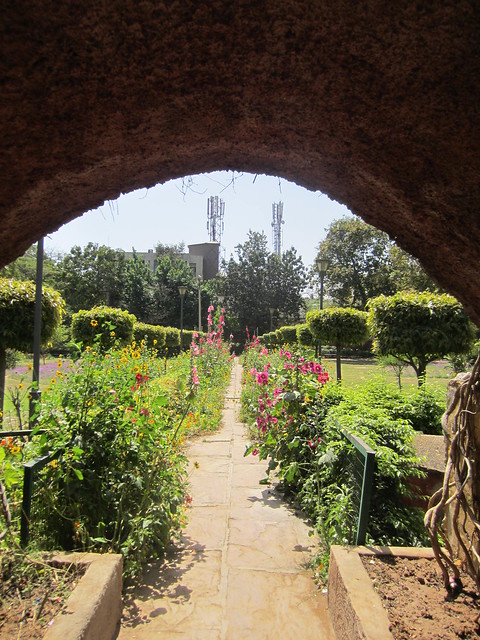
Landscaped garden

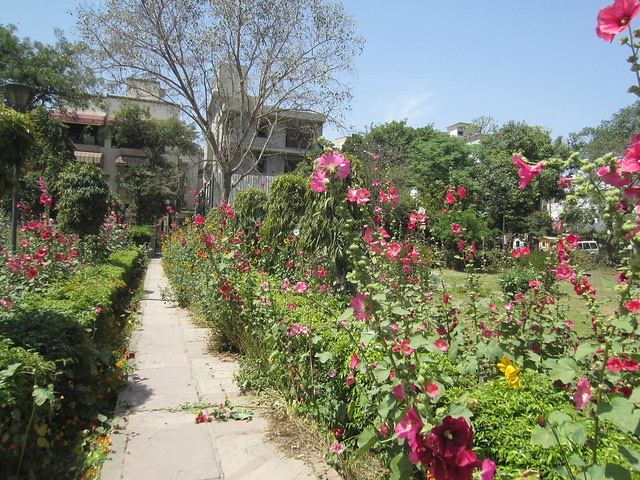
One thing I like about walking around my neighborhood is that every once you are surprised; okay, really I'm surprised quite a bit, but I'm talking about the pleasant escape type of surprise. In the middle of a housing block you'll find a square that is completely green. If you walk around it enough there is sure to be a gate on one side that will let you slip inside and escape the city. It is a neighborhood park. Or perhaps I would be better off saying neighborhood garden. There is a usually a path that winds either through the greenery and flowers or around it. A path that only take a few minutes to completely traverse, and yet it is long enough to force you to breathe deep, appreciate the overabundance of nature that can survive if given a little space, and remember that not everything is concrete.

Overgrown with flowers

Sunday, May 25, 2014

Roadside jobs: ladder maker

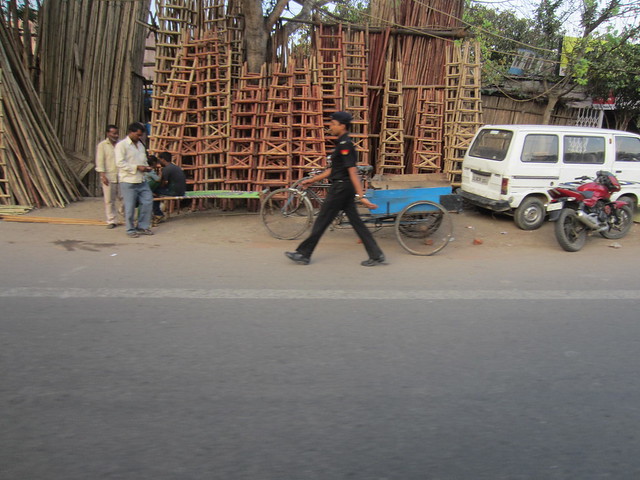
Ladder store


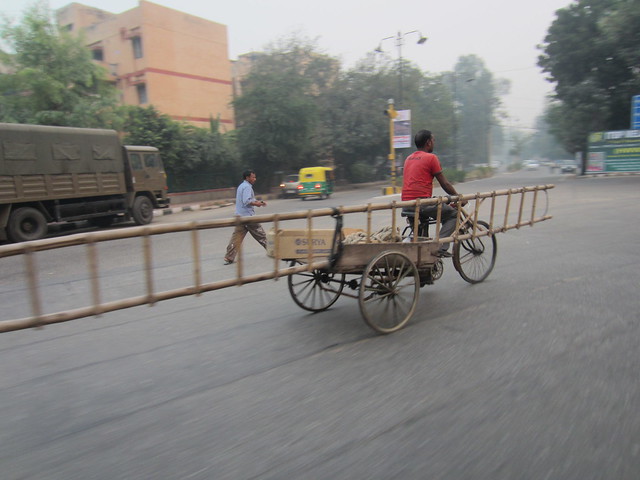
One of the roadside jobs here in Delhi that always captures my attention is the ladder maker. His work leaning up against a simple wall, you can see the choices. Do you need a ladder that is 3 feet or 4? Perhaps longer? Just make a stop of the side of the road and pick a wooden one out. I'm sure they can deliver it to you on a bicycle!

Ladder by bike

Sunday, April 6, 2014

Sulabh International Museum of Toilets


Yes you read the title right. An International Museum of Toilets. Perhaps the only museum of toilets in the world. And it happens to be in Delhi. Well according to our taxi driver, in a village that has been consumed by Delhi. How could you not want to visit it? The museum isn't all that outstanding - although a one room museum that kept our attention for over an hour must be pretty good...what was more impressive is the Sulabh organization. It is an organization that believes that toilets can be a tool for social change - helping to redefine the role of those who were untouchables or are scavengers. Part of their process includes getting more composting toilets which do not require people to clean them out and are actually more sanitary for low water areas than other options. They operate and maintain over 8000 public toilets which are kept impeccably clean and I believe have had a direct impact on health and sanitation in the areas where they have been installed. In fact the courtyard outside of the museum is a showroom of composting latrines - varying in size and price which can be installed.  (see their website for more information)

But back to the museum. The room is full of a variety of posters which share a portion of the history of the toilet. From guidelines to toilet use in Aryan times to poetry written about or on it. Such as this one that was specially inscribed at the bottom of a chamber pot:
I am as polite as ivory, but whiter than it,
Sometimes I am a virgin;
I am a bit delicate and hardly succumb to temptation,
Besides I never dream of being glorified.
      -ordered by King Louis XIV


The walls included humorous posters found in toilets, specialty toilets designed to resemble other objects like a stack of books or an armchair. There was a door made out of human excrement, as well as hard balls made out of the same. And a surprising number of advertisements encouraging people to visit the museum from all over the world. I must say that it is one of the most unusual museums I've ever been in. The sign as we left seemed to sum up their philosophy quite well:

Thoughts that matter:
*Smile you are in Sulabh
*Sanitation is our religion
*Perfect way to conquer worry - pray
*Museums are mirrors of heritage
*Do the very best you can


Sunday, March 30, 2014

Everyday adventures

Sometimes I'm surprised by just what it is that catches me off guard, and how easy it is to have unexpected adventures. Take this morning for example. Who wouldn't want to be prompted out of bed by a 10 piece band lined up along their neighbor's driveway? Especially if it comes complete with horns and drums? I couldn't resist stepping out onto my balcony and enjoying (hmmm...is that the right word?) the free music for a while. And of course taking a short video.


Or there is the experience of going to a friend's rooftop bbq to find that she had hired a Rajasthan Drum Troupe to perform for a good portion of the evening. Four young boys complete with led lights in a see through drum.


Or the fact that every time I see an elephant on the road it completely makes my day...and makes me wonder about where I have chosen to live.


And how can having my morning taxi weave its way through a herd of cows become everyday ordinary?


It makes you wonder what it would take to be really extraordinary.

Sunday, March 23, 2014

National rose garden

Between my mom's visit, minicourse with the high school students and Spring Break with my best friend, I have plenty to write about the upcoming weeks...I thought I'd share a mini excursion that mom and I fit in between my school schedule while she was here.


About a 10 minute walk from the school gate, on the route I drive to school every day, is a fenced in half block that is shockingly empty of buildings. With green grass covering the field and rose plants blooming in a pattern I had wanted to get to this garden but just never worked my way to it. When mom met me at school with two hours of downtime I decided it would be the perfect mini outing to fill the time. I was a bit surprised to find that the garden I wanted to visit was actually the National Rose Garden. Maintained by the Rose Society of India the sign at the entrance shared three aims: to disseminate knowledge of rose and rose growing; to encourage, improve, extend the cultivation of the rose by means of scientific trials; to hold exhibitions and other activities.


I'm not sure how much it reaches those goals, but it was a very pleasant green space to wander around and mom and I had a relaxing time literally stopping to smell the roses. My personal favorites were the orange tinged ones, although the mix of pink, red and yellow added to the garden's colorful appeal. Makes me wonder how many other small delights Delhi has to offer that I've never noticed before.


Sunday, March 2, 2014

Jantar Mantar, Delhi edition


While my mom was visiting I took the opportunity to visit several places that I had been wanting to get to but had never managed to actually find someone to accompany me. There was one place, though, that I had been purposely putting off until she returned to visit and that was the Jantar Mantar in Delhi. On her first visit we had explored the one in Jaipur and been captivated by the historical astronomy tools that towered over their small courtyard and had wished we had spent a bit more time soaking up the beautiful lines and scientific amazement that came with our visit. I was excited to take mom with me to see how the smaller Jantar Mantar in the middle of New Delhi would compare to what we had see in Jaipur. Made of red sandstone and white marble the contrast in the instruments make them stand out in the middle of the modern day city. Multi-story business buildings tower over the site and yet your attention is captured by these astronomical instruments that date back to 1724. The constructions truly reflect their name: Jantar means yantar or instrument and Mantar formulae. So Jantar Mantar is a site of formulae instruments. The observatory in Delhi is the first one built by Maharaj Jai Singh and as such is it not quite as ambitious in its instruments. There are four main instruments in Delhi. The towering Samrat Yantra functions as a giant sundial. The pleasantly curved Misra Yantra can determine the shortest and longest day of the year as well as provide the exact moment of noon in various locations. The pair of Ram Yantra with their arched rounded construction can measure the altitude and azimuth of different celestial objects. They come as pair with the open spaces of one corresponding to the solid rays of the other enabling an observer to place any shadow. The Jai Prakash Yantra are also a pair that are perfectly complementary. If you could lay them together no space would exist. It acts as a reflection of the sky above and is said to be so accurate that the other instruments were calibrated according to it. In any case, these ancient astronomical instruments are truly something to behold, even if I still can't quite get my head around how precise they still are.


Sunday, January 26, 2014

It is the little things


It is the little things that remind me I'm in Delhi. The way each week the dogs outside my neighbor's gate seem to have a slightly fancier place to rest - the most recent addition being some shade provided by a rainbow striped umbrella. How driving back from the airport this afternoon we passed approximately 20 men dressed in white and orange riding camels. The slightly crazy mural painted on the wall of the water department which includes a giant octopus with a third eye. The yellow and green tuktuks trolling the streets for passengers. These are just a few of the things that remind me I'm in Delhi. After all where else you could see this all within one car ride?

Sunday, September 15, 2013

Walking around the Qutb Minar

Courtyard view

A few weeks ago I realized I was at my last free weekend before volleyball started. Despite limping around with a cast on my foot I was determined to take advantage of time that would soon be in short supply. So I decided to take a trip to one of the main sites in Delhi which, despite it being the beginning of my third year, I had never visited...the Qutb Minar. On a bustling street corner, after crossing the road three times (turns out the ticket office is on the opposite side of the road from the monument itself) we entered into a green space whose main focus had my neck cricked back so I could stare into the sky. This sandstone column rises 72.5 meters (238 feet) into the air and is the highest stone tower in India. It was constructed as a huge minaret in the courtyard of the Quwwatu'l-Islam mosque which dates from 1198 and was pieced together using fragments of demolished Hindu temples giving an unusual design of stone work in a mosque. The Qutb Minar itself was begun in 1202 and continued to be added on to and renovated until 1503. In addition to this massive tower and the remains of the mosque there are numerous tombs on the grounds, a madrasa, an unusual iron pillar with a Sanskrit inscription (which may attribute its pristine state in part to being regularly covered in ghee in its past), and the rubble of the beginnings of a second enormous minaret which never got very far off the ground.

Iron Pillar and Mega Minaret

Friday, May 3, 2013

Access to Education

Backpacks packed

A few weeks ago I received this email, sent out to all of the faculty at our school:


Dear AES Community, You may recall hearing from me last fall, when we held our other “Big Event” for the part of ReachOut we call “Access to Education.” At that time, each year, we have the School Uniforms Drive; and each spring we have the School Supplies Drive…As always, we need your help! For those of you who don’t know, a proper Uniform and basic  School Supplies are the simple requirements necessary for admission into the Delhi state school system. We are now in our 23rd year of helping our Vivekanand neighbors meet this need. The value of Education is now fully embraced by the colony, with 100% of their children attending school…(and Zero percent engaging in begging or street performing)! So, please try to come to the Main gym, at 9:00 this Sunday morning (sorry, the Gym is not available anytime Saturday!). We will be sorting and loading a record number of backpacks (483!). After a 45-60 minute break, we will distribute the backpacks to the students of Vivekanand, at around 12:30. We won’t need as much help for distribution, but I encourage all who can to at least stop by to view (and photograph?) the milling Colony children outside of Gate 5, or those who come inside—12 at a time—to receive their backpacks. This year, Colony families are paying part of the cost of Uniforms and School Supplies, and will pay more each year, until we are only helping a few families who truly cannot pay. This is exiting and important. The colony has a much improved economy, as Education has improved their lives and IncomesTherefore, outside help is becoming less and less necessary. This event is a culmination of the efforts of many over the years. We continue to benefit from the ongoing substantial financial support of our generous PSA, and others. Gagan (Middle School Tech and teacher), Ram (a resident of Vivekanand, and now working in our main Tech dept.), Cheryl and I look forward to seeing  you this Sunday morning and/or afternoon. Come celebrate with us. Thanks from the “Access2Ed” Team,Jeff
One of the assumptions I had made coming to India is that I would be involved in more community service, how could you not be? Sadly that turned out to not be the case for me. True there are plenty of opportunities to support our students in their activities, but thanks to other obligations on my part I wasn't able to make a long term commitment in this arena. This, then, seemed like a way I could do something small to help support one of the long term successful programs our school engages in. I showed up at 9 and it took us just over an hour to unwrap and pack over 400 backpacks for the students that live in the colony across the street from the school. Thanks to the weather heating up we decided to distribute the bags early, and Ram took care of letting the families know that we would start early.

By the time we returned from a short break they were lined up outside the gate (lined up! one of the volunteers who has been involved with this for years said it was shockingly quiet and calm with very little pushing this year, perhaps they've realized we'll make sure every student gets his bag of supplies and there is no need to push and shove to be first.) Children were let in ten at a time. One group headed directly to they gym where their cards were checked to make sure they had met the attendance requirement we have in place (we'll provide supplies as long as they are actually attending school at least 75% of the time), another group sat on benches in the hallway, a third group sat on the sidewalk outside, the last group hung on the gate in the entryway waiting their turn to enter while a line stretched around the corner outside the gates. It was so great to see them excited to pick up their materials. The littlest accompanied by siblings, their eyes bright at the thought they would be going to school this year. Those in elementary and middle school excited to show us their papers saying they were ready to  move on to another class. The high schoolers I passed bags out to were to cool to seem eager, but when I spoke with them, particularly those who were starting their last two years, you could see the pride in their eyes. Pride in the fact that they were going to make it through school as their parent's hadn't.

I walked away humbled by how much the chance for an education means to these children. Pleased that there are people at my school who care enough to make sure that all of the children around us has that opportunity.

Starting school soon

Sunday, February 17, 2013

Purana Qila

Talaqi gate

We drive past it at least once a month. A seemingly tumbling down old red brick wall. Out front is a small pond which houses swan paddle boats and other amusements. I never imagined that behind the falling down wall would be another oasis of ancient architecture in Delhi. You'd think I'd have come to expect a green oasis when I enter an archaeological site here, and yet, every time it comes as a surprise. Surprise again, Purana Qila, the location referred to as the sixth city of Delhi was no different. A patchwork of green interspersed with old buildings all surrounded by a 1.6 km wall that was in rather good shape in certain parts and tumbling down in others. A brief oasis from the city, although there was still enough to remind you that you were still in India. We walked around the entire site, checking out the three distinct gates which showed just how the water level of the moat used to reach. The sandstone structures held remnants of their original tile decorations on the small turrets jutting up into the mostly gray sky. We contemplated a walk along the top of the walls in the back section, but decided we wouldn't chance the questionable descent on the other end. Instead choosing to follow a path down towards the lower levels of the fort which revealed broken down pillars and arched walls. A bit farther around to the Qila-i-Kuhna Mosque with its ornate stonework, triple niches in an unenclosed patio and a guard blowing his whistle to remind us to remove our shoes before entering. In the middle of the enclosure, just off the palm tree lined central pathway almost opposite of the grand Bada Darwaza entrance stood the Sher Mandal. Originally an observatory tower built by Sher Shah after he took the fort from Humayan, it was later turned into a library by Humayan when he retook this land. Perhaps, Humayan might have fared better had he not attempted to retake the fort, as this was the source of his death. One day, hearing the call to prayer, he rushed down the steps of the Sher Mandal, falling and injuring himself so badly that he died a few days later. Every time I venture out in this city I am struck by how much history there is hidden behind crumbling down walls.

Inside Purana Qila

Sunday, May 27, 2012

Humayun's Tomb

Humayans Tomb
While my mom was here visiting in the spring I took the opportunity of having a captive audience (really, whenever she comes to visit she just goes along with whatever crazy ideas I come up with) to go see one of the old Mughal constructions that I had been wanting to check out, Humayun's Tomb. Dating back to 1572, when you walk through the main gate and see the building through an arch, you can see how this is considered a precursor to the Taj Mahal with all of its arches and dome. The tomb is set in a lovely garden, provided an oasis of green in the center of Delhi, which also gives space for a few other "extra" tombs including that of the royal barber as well as that of the patron saint of Delhi, Nizamuddin Auliya.

Humayan's Tomb 
Arriving early in the morning we did not have to worry about fighting a crowd, and had the freedom to explore as we wished. I appreciated that this UNESCO World Heritage Site actually provided information about the construction of the garden and the buildings, provided small tidbits of trivia that captivated my interest. Like the story behind the lovely marble lattice windows. The story goes that while Mohammed was being chased he escaped into a cave and a spider threw a web all across the entrance. When the people who were chasing him came by they assumed he wasn't in there because of the web. The windows were designed to replicate the spider's web. Walking around you begin to appreciate the symmetry of the architecture and the gardens. The attempt to create a small section of paradise.

Sunday, October 16, 2011

Delhi's Red Fort

The red fort
Last weekend a friend and I headed into old Delhi to explore a bit. Our goal was the Red Fort (built in 1648), a name which clearly comes from the red walls that stretch 1.5 miles around nearly 125 acres of land. After a reminder that I should always carry my foreign registration card (the difference between a 10 rupee entry fee and 250 rupees) we streamed into the fort along with the crowds of Indians. I do appreciate that the tourism and heritage groups in India have kept the entry fees so reasonable priced that the locals can also enjoy the preserved heritage (even if it does make for larger crowds). We had to walk by a sandbagged guard (ummm...really, he'd just open fire?) and go through the woman's line to get patted down and our bags looked at, but then the peacefulness of the open architecture started to soak in. We spotted the Diwan-i-Aam, a pavilion where the emperor used to hold his public audiences, and figured that we should head in the direction. Most of the Indians were trying to capture a photo of the raised platform with ornate inlay where the emperor would have sat; I of course, was more interested in the arches holding up the pavilion. From there we wandered around the grounds, generally heading to less populated areas as we could see them, but making sure we looked at everything on the grounds: the private apartments of Mughal Emperor Shah Jahan topped by the scales of justice and with exquisite inlay (and more arches of course!), several side pavilions in white marble which screamed of tranquility, the Burj-i-Shamali a marble pavilion with a water chute which enabled residents to raise water from the Yamuna River below, the Moti Masjid, the Hayat Bakhsh Bagh which is a pleasure palace in the middle of a [dry] pool, and of course the out of place block barracks the British erected after the 1857 uprising. One lesson I did arrive at while wandering around and admiring the grounds and walls was that as I like taking pictures of people when I travel I can't really complain when others take pictures of me as we walk around. A lesson I'm sure I'm going to struggle to accept, but must if I'm not willing to give up the pictures I enjoy capturing the most.

For those of you who didn't realize it, the colored words in my posts are links which will take you to appropriate photos....

Tuesday, October 4, 2011

Mehrauli Archaeological Park

Finally. Finally I am starting to go our and see a bit of Delhi. Or at least I've made a start. I'm not sure I can say I'm finally starting if I don't see anything new in the next few weeks, but at least I've succeeded once. Saturday afternoon I joined a group of friends from school to go on a walking tour with Surekha who runs monthly walks around different areas of the city. This month was in the area surrounding the Qutb Minar, a 72 meter tall minaret  built between 1211 and 1236. To the south is Mehrauli Archaeological Park, a lush oasis in the middle of the city filled with remnants of building from the Mughal empire.
Azim Khan's tomb
However, that is not where we started. On the walk towards the park we took a slight detour to climb up to Azim Khan's Tomb. The renovation has just recently been finished and while there is some debate as to if it is the tomb of a general or the son of one of (Mughal Emperor) Akbar's wet nurses it is a pretty little place amid a block of green that provides nice views of the city...and a giant Buddha statue across the way.
Folly
Back down to the street we went to head to Mehrauli. I was constantly amazed that we didn't have to get very far away from the busy Delhi streets to end up surrounded in a quiet green growth. We walked over to what had, at one time, been quite a little estate. Across the bridge spanning a canal, then on to look at the boat house which now just overlooked a cluster of plants. Turn around to find a steep series of steps leading up to what is sometimes called Metcalfe's Folly. Originally it was the tomb of Mohammad Quli Khan (brother to one of Akbar's foster brother). In the early 1800s Sir Thomas Theophilus Metcalfe, British resident at the Mughal Court, decided to convert it into his summer residence. Yes, the tomb itself was turned into the dining room of his house with some wings added on to finish it up.
October 1, 2011
From there we went on to what was probably my favorite sight, the Rajon ki Bain boali or step well. A four level well built in 1506, which provided access to water at every level step wells often gathered small communities around their edges in the covered wings. We then continued to wind our way through the park as the sun started to set. Taking quick glimpses at small ruins along the way, including Balban's tomb dating back to the 13th century (Slave dynasty ruler of Delhi Sutanate), a pavillion with scrafitti on the ceiling (a term I had never heard before but referring to some kind of scratched in artwork), and a crumbling tomb of a Sufi saint that has been forgotten.
Jamali Kamali Tomb
The final stop on tour was the Jamali Kamali tomb. Our guide wanted to save the best for last, unfortunately that meant we arrived after dark and my best view of the tomb came when I was looking at my pictures on the computer the next day. It really was unfortunate as our guide actually had to get someone to unlock the tomb so that we could see inside. This tomb containing Jamali (Sufi Saint and poet Shaikh Fazlu’llah) and  Kamali (an unknown male companion) dates from around 1535 and has recently been renovated by the Archaeological Society. It is locked up in fear of people coming in and defacing the painted ceiling, ornate decorations or marble mihrab.

By the time we finished there it was dark and we carefully picked our way back to the street to jump in a rickshaw to head to dinner. I'm glad I took a few hours out of my day to get out and see a little bit of the history that Delhi holds. Now the question is, what next?