Sunday, April 28, 2013

Learning to dress

I received an invitation to an event this weekend that called for formal or Indian dress. I thought it would be a perfect excuse to finally wear the sari that I had bought at the beginning of the year and has been laying folded in my closet since then. But how? How was I to get this three meters of fabric wrapped around my body? Wrapped so that it would not fall off, and would look *something* like what it is supposed to (I suppose perfect it too much to ask of a foreigner!). Luckily my maid Mrs. Kaur was at my house Saturday morning. I asked her to help me learn what I was doing. Thirty minutes later I was laughing in amusement, but fairly sure that I would be able to wrap myself up reasonably well that evening. To begin with she had me put on the petticoat, an integral part of the outfit as it actually holds the entire thing up, tucking the first round into the waistline, tugging all over to get it to hang straight, just barely brushing the floor. A lot more adjustment, some discussion as to how I wanted the end to drape, and she continued to even things out. Working from both sides she gathered the excess material in the front, carefully folding seven pleats into the fabric then tucking those into the front. With four adjustments to the folds over my shoulder I was starting to wonder how in the world I would ever get it put back on four hours later. Luckily she had a plan. A couple of safety pins held both sets of pleats in place, an extra one lower down would keep them from falling out until I was dressed later. Then it all came off and I tried to replicate the look. The first attempt wasn't so good! I got a couple of reminders and took it back off to try again. We didn't stop until I passed Mrs. Kaur's inspection. I'm sure it wasn't perfect, but she decided it would be good enough. Then she reminded me to add a few safety pins in key spots to hold everything in place and let me take it all off. I guess she tutored me well and I got several compliments from the Indian women at our event, goodness knows I couldn't have done it without her! I can't say a sari would ever become my daily outfit, but I did feel very elegant in it, even if it was a bit like playing dress up.

Saturday, April 13, 2013

Morning view

Beginning sunrise

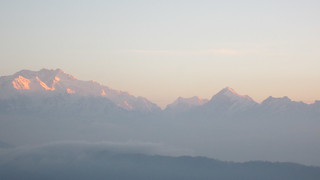
A knock on my door at 5:15 woke me from an uneasy slumber on a wooden pallet. As I contemplated the reason for the early wake up I knew I was going to have to give up my warm cocoon for the frigid air. I quickly tumbled out, added another three layers to what I was already wearing, tugged a cap over my head, slipped on my mittens and grabbed my camera. As I stepped outside, despite the wind whipping by, I breathed a small sigh of relief. The sky was clear so we should get good views with the sunrise. I clambered up on a rock, trying to position myself for a good view (and photos without other heads in them). There was just a hint of pink on the tip of Kanchenjunga as the sun began its slow rise. Click, click. It seemed every minute I was taking another photo as the light spread a bit wider highlighting more of the range. Now you can see the upper outline they call the sleeping Buddha. Click. Light has reached the lower peaks. A glimpse off to the east and the sun is starting to appear over the pine trees. Duoa, our guide, directs my attention to the west. As I slide down the rock a bit to get around a tree in my sight, I snatch my first glimpse of Mt. Everest. Proudly poking above the clouds, the sun is just now starting to lighten its face. I can't believe how big it is. A mountain above mountains. Yeah, yeah, you know its the tallest mountain in the world, but until that moment I didn't realize just what that meant. The idea that people actually climb to the top flabbergasts me. It seems to remote, so up there, that I can't quite believe that even at this moment there may be a group of climbers pushing to summit. For me, the view from this point is good enough. Well almost. I go clambering down and walk as fast as I can to the upper hill of this camping town, looking for that one spot that will give me an unspoiled view of both Kanchenjunga and Everest. A view that doesn't have trees marring the way. A view that I will hold in my head as we walk all the way back down to road. 

Everest from India

Saturday, April 6, 2013

Hiking in India

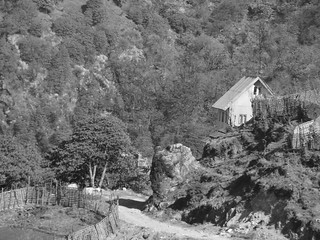
misty path

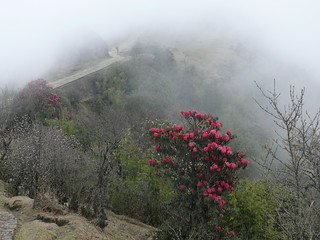
I had a hard time deciding what to do this spring break. Did I want to stay in India or travel elsewhere? Was there anyone going someplace I was interested in? (The answer to that one ended up being no) In the end I found a group that was organizing a trek along the Singalila Ridge in West Bengal, India along the borders with Nepal and the state of Sikkim. That is about all I knew, but decided that since I liked spending time outside in clean air it would be interesting to do the five day hike. 
Looking out

What did I get myself into? The first three days we were hiking mostly uphill on rough rock paved roads. Little did I know we would spend half of a day in Nepal.  Crossing a border where it seemed only India cared, forcing us to sign out on a paper register but not marking a thing on my passport. I know I left India, but I'm not sure when I actually entered Nepal as they didn't seem nearly as concerned about record keeping (of course India only cared about the two foreigners in our group).

Path

Each afternoon we pulled up at a tea house where lunch was being fixed. Of course that wasn't our first stop of the day. Usually we stopped at least once for a break to drink a cup of tea, either black or with milk. At one of the tea houses our guide got us a glass of the local rhododendron wine (made from the red flowers not the white) which is a local medicine for just about everything. At another the guys had fun getting the chickens to snatch crackers out of their hands. One day the entertainment was getting the goats to look the honey off their finger. At still another I couldn't resist taking pictures of the kids sitting at the side of the house. 

After three days of climbing up we were at the highest point of our trek, Sandahkphu, where if the weather was in our favor we had been told we would be able to see the Himalayan Range, including Mt. Everest and Kanchenjunga. Well luck was with us and the next morning we got to see the world's highest and third highest mountain (but more on that later). 

Beginning sunrise

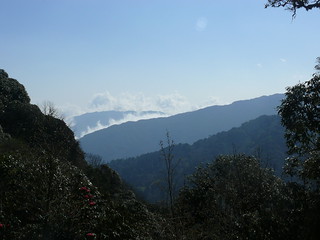
The last two days we went mostly downhill, and I have to say that the fourth day was by far the most difficult. When you go down in the Himalayas, you really go down. Down through a forest of bamboo, fire burned remnants and rock paths. Down until you reach the flowering slopes of the small village of Ghum. A restful oasis where we spent the night. It was a good thing we only had a couple more hours to go the next day before climbing into a car to head back to Darjeeling as I was so sore I could hardly take a step down the next three days. As we rolled up to our hotel I have to admit I felt a mixture of relief, success along with the thrill of knowing a hot shower was just minutes away.

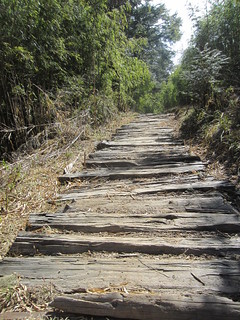
wooden path

For not having much of an idea what I was getting myself into I ended with a pretty spectacular Spring Break that took me from 2200 meters up to 3636 meters, from mountain fields through forest to bare top views of snow capped mountains. The Singalila Ridge trek was definitely an adventure. 

Sunday, March 24, 2013

The benefits of fashion


How many fashion shows have I been to in my role as a high school teacher? Way more than I ever would have dreamed. Of course one probably would have been more than I ever dreamed. Last weekend brought that count up to five, or is it six? Although I will say this one was a bit more student involved then the ones in Asuncion. Four IB diploma students decided to take on the task of organizing a fashion show to benefit a NGO which works on women's rights and safety. An area in India that is increasingly coming to the worlds notice with reports on gang rapes, young girls being forced into prostitution and domestic violence. (In fact did you know that in the week following the well publicized gang rape and the subsequent death of Jyoti there were 9 more rapes reported in Delhi, and that is only in Delhi, and only the ones that were reported). What made this fashion show different? Nine students designed their own collections (okay, three collections designed by groups of three students), employed tailors to sew them, and other students to model them. The even which took place on the gardens of the Australian High Commission was a big undertaking, and provided us with an excuse to dress up for the evening, plenty to observe and perhaps a reminder of the need to choose a side in the women's right campaign that seems to be gaining strength in India.

Sunday, March 17, 2013

Rafting outside of Rishikesh

Entering a rapid

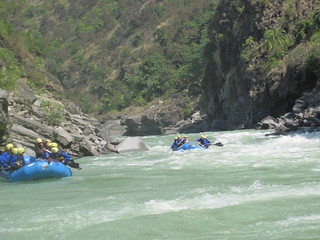
In the foothills of the Himalayas, with only a large dam to observe, we put three rafts into the Bhagirathi. A stretch of river that is remarkably isolated and untouched in heavily populated India. I did not even know that such places existed in this country. I spent three hours paddling through the white water with 19 students, 2 other teachers, and 5 guides. Untouched India. I never dreamed I'd get into that, much less thanks to school and the trips it sends the high school out on every year. This year I signed up for a rafting trip. Having never rafted I wasn't at all sure if that was a good choice, or if I it was a mistake for my first experience to be with 19 high schoolers (the answer to that is mixed...). Luckily we had a good group, some nice water, beautiful scenery, and enough rapids to satisfy those thrill seekers among us (which I'm determining is not really a word that describes me). We rafted on three separate days. Two days on the river Ganges, and for the third we headed upstream, past where the Ganges technically starts, to raft the western branch called the Bhagirathi River. One of the tributaries that joins the Alaknanda River at the confluence to form the Ganges. I'll admit I was having a great time, enjoying the scenery, our campsite, the down time and, yes, the students, until I was on the one raft that flipped over the last day headed into Rishikesh on the Golf Course rapids. I suppose it wasn't really surprising, as I did learn that the only way to get through rapids is to paddle through them (well that or float on your back while the water splashes you in the face) and with high school girls in my raft who stopped paddling as soon as they got hit by any water it was just a matter of time before we went over. I've decided to look at it as being thoroughly blessed by the river Ganges, washed clean inside and out after going completely under then swallowing a good amount of water before I could be pulled back into a raft. It just goes to show you never know what a trip will bring.

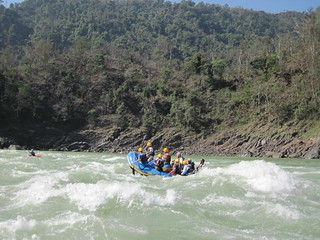
hitting rapids

Sunday, March 10, 2013

Daulatabad Fort

View of Daulatabad Fort

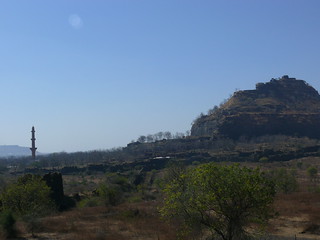
You enter at the floor of the plain, climb a few steps to what must have been the outer keep as walls surround it. Past an old temple and a slightly newer mosque built to commemorate some victory. That was after handing out tickets over at the first gate - giant wooden doors complete with iron spikes to keep the elephants from crashing the door down. The path from there becomes a series of steep stone steps and right angled turns. They were not going to make it easy to get into this fort. After we passed through another set of double doors and crossed a mostly dry moat, me entered a small courtyard with a sign pointing to the dark tunnel. Dark tunnel indeed! Thank goodness for the flashlights on our phones. I am sure that this tunnel/staircase they carved out of the rock would have been pitch black without them. Even with the small light it was tricky enough to turn the correct corners and not to go into an empty side room filled with bats. I imagine it was a remarkably effective defense mechanism. When we got out of that tunnel and the slightly better lit one after it, I believe we were on the fourth (?) level of the fortification. From there you could look out over the walls to a scenery that looked remarkably like the American Southwest. You could also look over the rather steep walls hewn into the rock. Still a few more levels to go up. The next took us to a white building which I suspect was the main habitation of the fort. It had a loggia with arches that looked out over the valley. The school group that followed us up meant we didn't dwell. Another staircase around the corner led us up almost to the top. Another leveled plateau with a few remnants of building there. A single stone structure stood in the center - all that remained of our quest to make it all the way to the top. Of course you have to walk around to the backside to find the stairs, then just two short flights (scarily not against a wall this time) lead us to the penultimate height of the Daulatabad Fort to find the six meter cannon that laid there. There was definitely quite a view from the top. A few minutes to soak it in and snap a few photos then there was nothing to do but head back down - a much more painful part of the adventure for your joints. Down all those steep stairs, past the monkeys chilling in the trees, through the lighter tunnel (what you mean we could have avoided the dark one?) and on down past fragments of decoration that hinted at how the fort used to be carved. Our exploration was finished after one photo with our tuktuk driver for his album.

Sunday, March 3, 2013

The Ellora caves

Monk stepping out

When people asked us where we were going we said "the caves," as if the Ellora and Ajanta Caves are a single entity. It's not true. They are two distinct sites relatively close to each other, albeit with a similar background. The Ellora caves pick up where the Ajanta caves left off, starting off around 600 AD. No longer are the caves solely a Buddhist thing anymore. Distinct sections of this collection of caves belong to Buddhism, Hinduism and the Jain faith. All worked on around the same time they are an early testament to religious tolerance in India.


Another hole

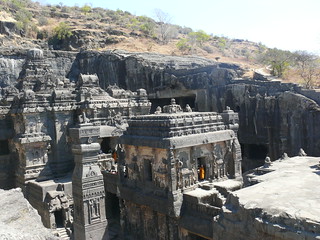
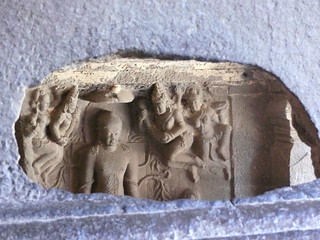
I had no idea what to expect the second day we went out to explore the caves. I knew there were different types of caves based on religion, but somehow I expected to see something almost identical to the day before. Our guide led us into cave number 16, the largest Hindu cave, and my jaw dropped open. Literally. You make it through the entrance of what is not exactly a cave and is more a full temple carved out of the hillside to find a two story structure completely covered in detailed carvings. There are wall sections that retell stories in intricate small carvings. A lower border of elephants and lions. Numerous Hindu gods along the walls. Two pillars standing tall near the remnants of large stone elephants. Everywhere you look there is a detail that catches your eye. What is that up on top? Oh, is that a face blowing wind? I have to admit that I didn't hear much our guide said as I was too busy trying to take it all in. And that's just one cave. There are over 30 caves at Ellora. Although not all of them are as ornate. The Buddhist ones aren't too different from Ajanta, with elaborate facades and simple interiors. The main Jain temple is almost as ornate as the Hindu one, with a still standing stone elephant, two stories of initially decorated walls, numerous (naked) gods on the wall, a spacious second floor with pillars, flowers on the ceiling and more gods carved into the wall. It is actually quite amazing what people were able to do with a set off simple tools and how well they must have been able to picture a final product in their head that took over 100 years to complete.