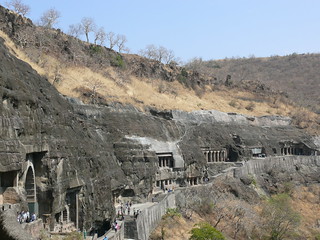
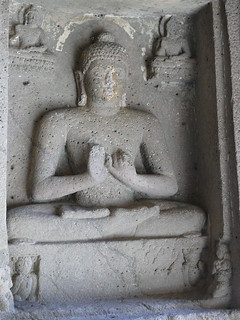
A two and a half hour drive from the airport in Aurangabad to the middle of, well, nowhere, then a short climb up a hill (unless you rent a chair and four porters). As you crest the top they spread out before you, along the curving cliff side. The 29 caves of Ajanta. Dating as far back as 200 BC with the most recent from around 650 AD these caves were dug by hand out of the volcanic rock. Chipped away from front to back and top to bottom, they are stunning to explore. All of these caves were carved out for a Buddhist community and consist of five temples with the remaining caves serving as monasteries. They are full of pillars and carvings, decorations carefully planned and left in the rock. In the back of most caves sits a small room dedicated to a large statue of Buddha. A few contain ceiling high stupas (basically a Buddhist reliquary). Others were covered in paintings depicting the life of Buddha. Towards the middle you get to some with ornate two story facades, covered by carvings of Buddha in various forms. At the far end one uses half of a wall for a reclining Buddha. I continually found myself staring along the cliff side, looking at how many more caves remained, shaking my head to think that before talking to people in my office I hadn't even known these existed. How have they escaped the attention of the world for the most part?
Sunday, February 24, 2013
Ajanta Caves
A two and a half hour drive from the airport in Aurangabad to the middle of, well, nowhere, then a short climb up a hill (unless you rent a chair and four porters). As you crest the top they spread out before you, along the curving cliff side. The 29 caves of Ajanta. Dating as far back as 200 BC with the most recent from around 650 AD these caves were dug by hand out of the volcanic rock. Chipped away from front to back and top to bottom, they are stunning to explore. All of these caves were carved out for a Buddhist community and consist of five temples with the remaining caves serving as monasteries. They are full of pillars and carvings, decorations carefully planned and left in the rock. In the back of most caves sits a small room dedicated to a large statue of Buddha. A few contain ceiling high stupas (basically a Buddhist reliquary). Others were covered in paintings depicting the life of Buddha. Towards the middle you get to some with ornate two story facades, covered by carvings of Buddha in various forms. At the far end one uses half of a wall for a reclining Buddha. I continually found myself staring along the cliff side, looking at how many more caves remained, shaking my head to think that before talking to people in my office I hadn't even known these existed. How have they escaped the attention of the world for the most part?
Sunday, February 17, 2013
Purana Qila
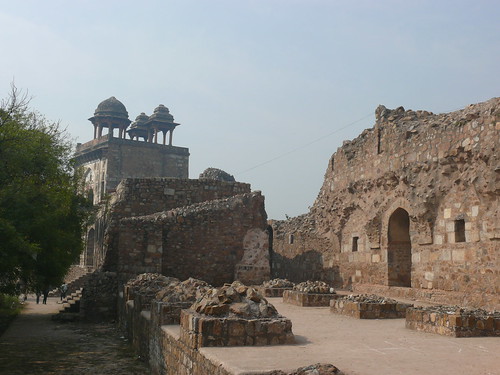
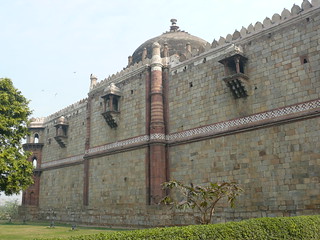
We drive past it at least once a month. A seemingly tumbling down old red brick wall. Out front is a small pond which houses swan paddle boats and other amusements. I never imagined that behind the falling down wall would be another oasis of ancient architecture in Delhi. You'd think I'd have come to expect a green oasis when I enter an archaeological site here, and yet, every time it comes as a surprise. Surprise again, Purana Qila, the location referred to as the sixth city of Delhi was no different. A patchwork of green interspersed with old buildings all surrounded by a 1.6 km wall that was in rather good shape in certain parts and tumbling down in others. A brief oasis from the city, although there was still enough to remind you that you were still in India. We walked around the entire site, checking out the three distinct gates which showed just how the water level of the moat used to reach. The sandstone structures held remnants of their original tile decorations on the small turrets jutting up into the mostly gray sky. We contemplated a walk along the top of the walls in the back section, but decided we wouldn't chance the questionable descent on the other end. Instead choosing to follow a path down towards the lower levels of the fort which revealed broken down pillars and arched walls. A bit farther around to the Qila-i-Kuhna Mosque with its ornate stonework, triple niches in an unenclosed patio and a guard blowing his whistle to remind us to remove our shoes before entering. In the middle of the enclosure, just off the palm tree lined central pathway almost opposite of the grand Bada Darwaza entrance stood the Sher Mandal. Originally an observatory tower built by Sher Shah after he took the fort from Humayan, it was later turned into a library by Humayan when he retook this land. Perhaps, Humayan might have fared better had he not attempted to retake the fort, as this was the source of his death. One day, hearing the call to prayer, he rushed down the steps of the Sher Mandal, falling and injuring himself so badly that he died a few days later. Every time I venture out in this city I am struck by how much history there is hidden behind crumbling down walls.
Labels:
delhi,
fort,
india,
Purana Qila,
Purana Quila,
ruins,
tourism,
travel
Sunday, February 10, 2013
Wild Ass
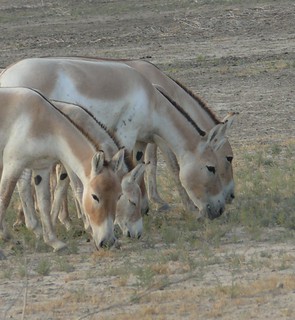
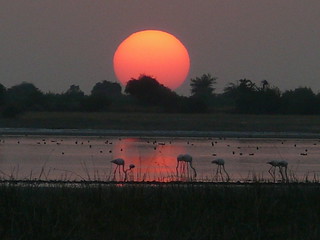
The real reason we headed up to Ahmedabad over Diwali break was that it was the closest point we could get to in our trip out to the Little Rann of Kutch. "The Little Rann?" I can hear you question. It's a dry, cracked, almost barren desert that is home to India's Wild Ass Sanctuary. Taking up almost 5,000 square kilometers of the state of Gujurat, in the middle of the salt flats, lies the protected area for close to 3,000 Indian wild ass. India has done a remarkable job conserving space for this species which used to roam from western India, into Pakistan, Afghanistan all the way to Iran. Now the ass have a restricted area where they are safe to kick up their heels, graze in peace and provide a fair amount of entertainment for tourists on safari. Of course there continue to be threats to the wildlife, with poachers encroaching on the protected land and an increase in salt farms flooding land that was grazing areas. For now though, the wild ass are prospering along with the myriad of other animals to be found in the desert - nilgais, hawks and other birds which stop at the wetlands during their migration (including flamingos!). It was an unexpected safari of a variety of animals in the middle of the desolate Little Rann.
Labels:
animal,
ass,
Gujurat,
india,
Little Rann of Kutch,
safari,
tourism,
travel,
Wild Ass Sanctuary
Location:
India
Sunday, February 3, 2013
Ahmedabad
Only in
India would there be a city of several million that you had never heard of. But
over the Diwali break I has headed to one of those. Ahmedabad. A city it took
three people about 10 tries to teach me how to pronounce correctly on the bus
out to the plane. A city that is home to some extraordinary wood and stone
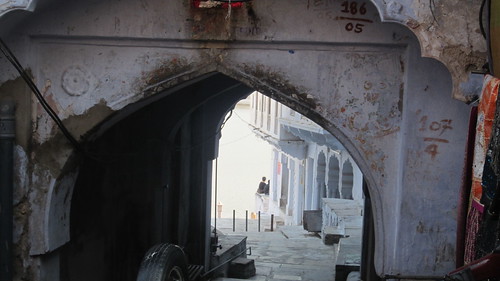
carving. When you wander through the old
poles (ethnic/religious neighborhoods) of the city it is easy to spot the old
houses as they are covered in carvings. Sometimes just geometric designs,
flowers and such but just as often images of dragons, lions, peacocks, horses and
gryphons. The detail was amazing and meant I had a hard time keeping my eyes on
where I was walking as all I wanted to do was keep looking up. At certain corners
you would find a birdhouse standing proud, structures built to allow the
residents to leave food and water for the birds in an area where trees were not
all that common. And yes, I did see some residents pouring water into bowls
when we took an early morning walking tour. But the most spectacular sight of
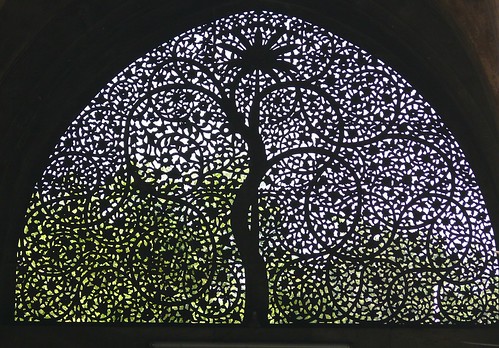
all was the stone carvings. The trees of life which could be found as adornment
on the Jami Masjid mosque and the absolutely stunning carved windows of the
Sidi Saiyyed mosque. I could have stood in awe for an hour just appreciating the
design and work that had gone into those. Really made it worth the journey to
Ahmedabad even if it that wasn't the purpose of our trip (that will have to
come in another post though).
Location:
India
Sunday, January 27, 2013
Colorful Pushkar
Along with the camel fair, Pushkar also brings in a load of pilgrims on a religious journey the same week for Kartik Purnima. The city is home to one of the few temples dedicated to Lord Brahma (I think only four other temples in India are dedicated to Brahma) and the main attraction of the city any other time of the year is that temple and the 52 ghats that encircle a holy lake believed to have been born from the tears of Lord Shiva.
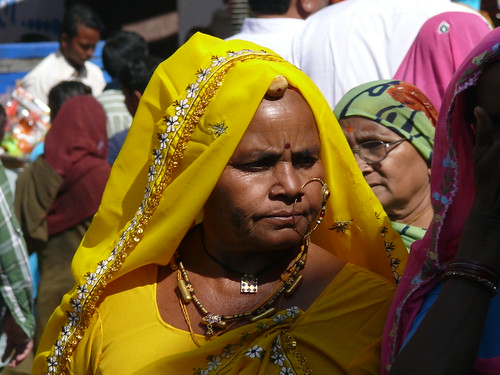
So, while the camels were definitely the draw for me to go to Pushkar, I found the streets to be a whirling, chaotic collection of color. Families were visiting for the chance to combine a shopping trip with a religious pilgrimage with a livestock exchange. I was happy to sit on a street corner and snap picture after picture, trying to capture the many faces of Pushkar. There were the women with their brightly colored saris, so bright sometimes they almost hurt the eye. The vendors settling down onto the roadside, spreading their wares out on blankets to sell. Did you see that man go by? His forehead is all painted! And that one just set down a big pot on a stand, I wonder what he is selling? Ahh...she has quite the large nose ring! That girl is posing (at least it sure looks that way!). While the others are clearly busy shopping. Hmmm...the food is almost as bright as the clothes, sometimes I wish I felt a bit more adventurous in terms of trying the street food. There is so much color I hardly know what to focus on.
Sunday, January 20, 2013
Camel Fair
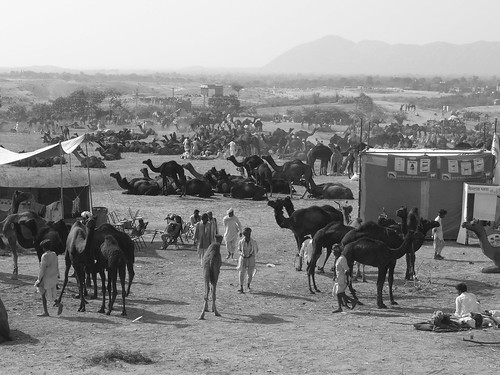
The camel
dancing was just one of the many sights that awaited me as I made my way to
Pushkar for the annual camel fair, the
oldest continual animal fair in the world. Along with the dancing there were
camels "dressed up" with patterns shaved in their fur, flowers on their noses, necklaces and
garlands looped around their necks and at times dyed tuft of fur at the top of
their humps. Those were clearly the fancy camels. The ones meant to pull
tourists around in a cart or give them a ride on their back. If you made it to
the back of the fair grounds, that is where you could find the serious camel
traders. Close to 50,000 camels I would guess, scattered across the desert
hillside. When I climbed up on a wall I couldn't believe just how many had
converged on Pushkar for the five day festival. There were camels everywhere!
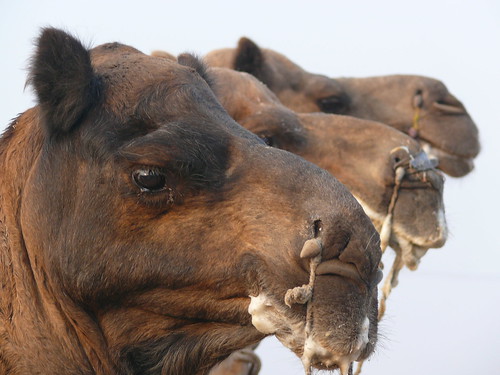
Standing and sitting in groups, outside of their owner's tents. Waiting
impatiently as a buyer pulled open its mouth to check the teeth. Smacking its
jaws as it ate from a pile of feed. Nuzzling a baby camel by its side. Bowing
spit bubbles and drooling on unsuspecting tourists that wandered too
close. These are the sights of the
Pushkar camel fair that will forever be imprinted on my mind.
Location:
India
Saturday, January 12, 2013
Christmas in Italy
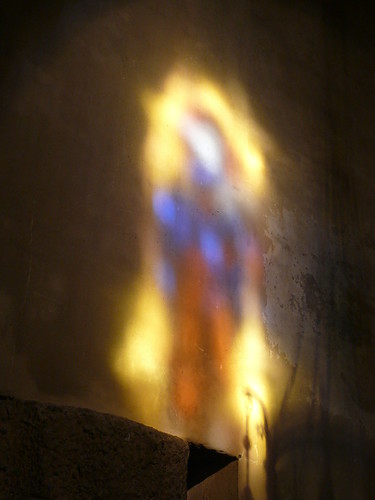
Stained glass window on the walls of the duomo in Siracusa
How do you sum up three weeks of travel around a country that included 8 cities? After spending two days sorting through pictures I'm not at all sure I'm up to writing anything extensive; so I thought I'd share some of my highlights from our time in Italy.
- The brightly colored houses on the island of Burano outside of Venice
- Riding the funicular part of the way up the mountain around Trento to Sardagna and the spectacular view of the Dolomites from that vantage point
- Some of the unusual nativity scenes scattered around Assisi
- Discovering my favorite church window in Italy is still the rose window of San Rufino in Assisi...from the outside
- The bridge of angels leading across the river to Castel San'Angelo in the Vatican
- The pure cheesiness of visiting Juliet's house and tomb in Verona
- The absolutely spectacular golden mosaic behind the altar in the Church of Maria in Trastevere, Rome
- Relaxing among the historical building and sea front on Ortygia Island in Siracusa, Sicily
- Even more cheesiness at the Boca della Verita on the wall of Santa Maria in Cosmedin in Rome where legend has it that if you tell a lie with your hand in its mouth it will bite your hand off
- Hearing the church bells ring through the clear clean air
- Watching mom enjoy gelato almost every afternoon
- The overwhelming size of the Colosseum sandwiched in the middle of Rome
- Not having to spend Christmas alone this year and having my mom for company
Mom and I in the Arena in Verona
Location:
Italy
Subscribe to:
Posts (Atom)